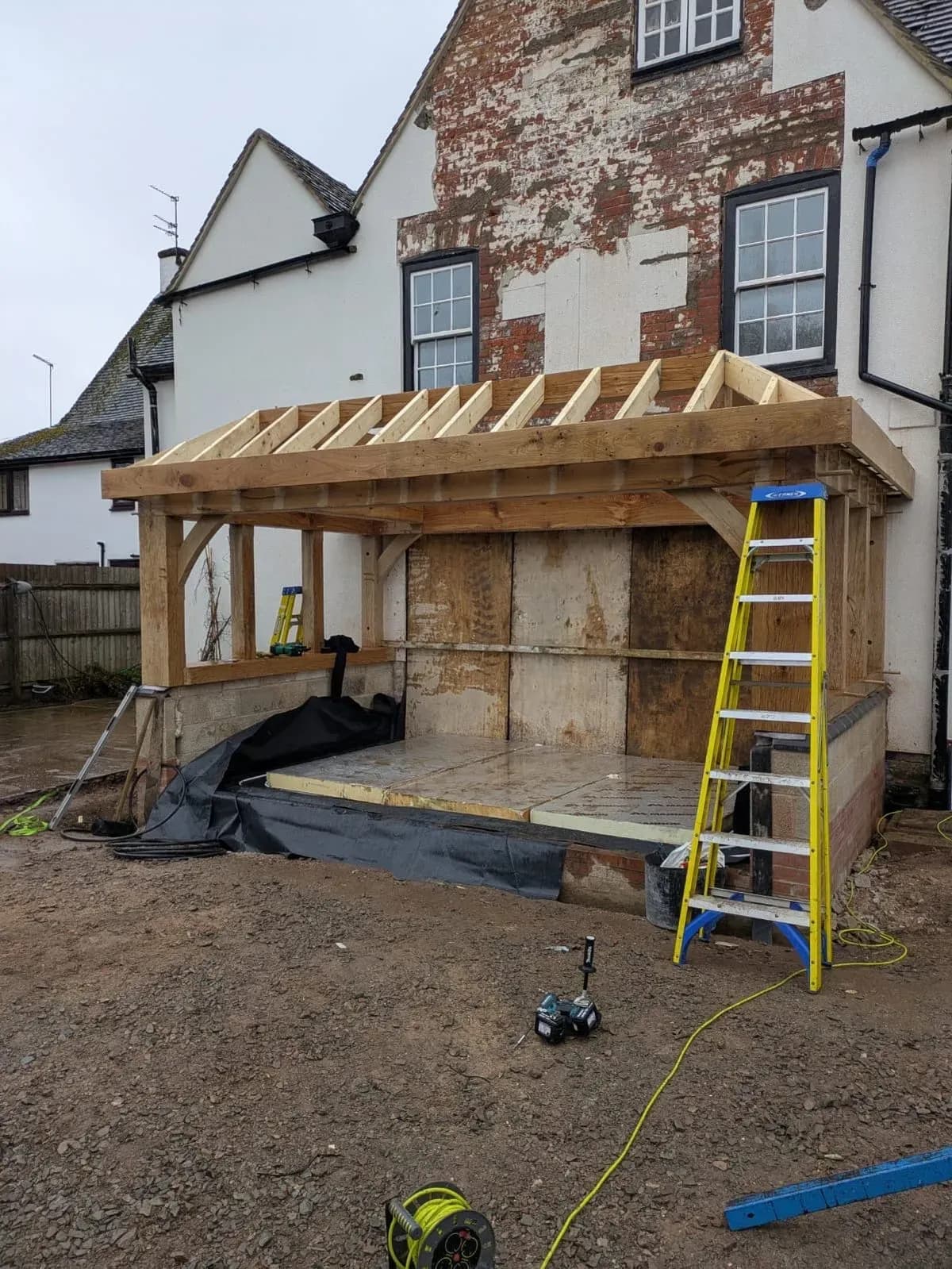
The right foundation type depends on your soil, your structure, and your site conditions. Here's a clear explanation of the most common foundation types used in UK construction.
Foundations are the most critical part of any building — yet they're the part that most homeowners never see. Getting the foundation right for your ground conditions and the load of your proposed structure is non-negotiable. Here's a plain-English guide to the most common foundation types used in UK residential and commercial construction.
Strip foundations are by far the most common foundation type for houses and extensions in the UK. They consist of a continuous strip of concrete laid beneath load-bearing walls, distributing the building's weight across the ground below. In most UK soil conditions, strip foundations need to be at least 1 metre deep to avoid the risk of movement caused by seasonal shrinkage and swelling of clay soils. Where tree roots are present near the site, the depth may need to increase to 2–3 metres.
Wide strip (or T-beam) foundations are used where the soil has a lower bearing capacity, as they spread the load over a wider area. This is a common solution for moderately soft ground conditions in parts of Leicestershire.
Raft foundations consist of a continuous reinforced concrete slab that covers the entire footprint of the building. They are used where ground conditions are soft, variable, or where there is a risk of differential settlement. A raft distributes the building's load across the maximum possible ground area, reducing the risk of uneven settlement. They are also commonly used for buildings on made-up ground (former building plots, filled land) or where site investigation has revealed variable ground conditions.
Piled foundations transfer the building's load deep into the ground through steel or concrete piles, bypassing weak or unsuitable surface soils. They are required where ground conditions are very poor (such as peat, highly compressible soils, or very loose sands and gravels) or where the building is very heavy and requires load transfer to a firm stratum at depth. Piling is also used where the existing ground cannot safely bear the load without excessive settlement.
Regardless of foundation type, a structural engineer must design and specify the foundation, and building control must inspect the excavation before any concrete is poured. This is a legal requirement in the UK and is non-negotiable. At Spectrum Construction, we work with qualified structural engineers on all our foundation projects and manage the building control process on behalf of our clients.
Key Takeaways
- Strip foundations are the most common for residential buildings
- Raft foundations work well on soft or variable ground
- Piled foundations are required on poor or deep-fill ground
- All foundations must be designed by a structural engineer
- Building control must inspect foundations before concrete is poured